How to Deploy Kimi K2.7 Code
Kimi K2.7 Code architecture, hardware requirements, and production serving tradeoffs.

Aryan Kargwal
PhD Candidate at PolyMTL
Published
Topic
Model Deployment

TL;DR
|
Coding agents are becoming less like autocomplete tools and more like long-running software workers.
A single task can now involve repository exploration, shell commands, test failures, tool calls, code edits, retries, and continued reasoning across the same session. The serving workload grows with every step.
Kimi K2.7 Code is built specifically for that kind of long-horizon software engineering. Moonshot AI reports stronger coding and agent performance than K2.6 while using roughly 30% fewer thinking tokens on average.
The model also creates a very specific inference problem. K2.7 Code has 1 trillion total parameters, activates 32 billion parameters per token, supports a 256K context window, and always runs with thinking enabled.
A production coding agent can therefore keep source files, terminal output, tool responses, previous reasoning, and generated patches inside one growing session. Longer sessions increase cache pressure, extended reasoning increases decode work, and concurrent agents compete for memory and scheduler capacity.
Deploying Kimi K2.7 Code means solving for the workload around the model. This guide examines its architecture, coding and agent benchmarks, native INT4 deployment path, GPU requirements, context and reasoning overhead, and the runtime decisions that affect low-latency serving.
What is Kimi K2.7 Code?
Kimi K2.7 Code is an open-weight coding model from Moonshot AI, the Beijing-based AI lab behind the Kimi model family. Moonshot has focused heavily on long-context models and agentic systems, with the K2 family extending that work into coding, tool use, reasoning, and extended task execution.
Kimi K2.7 Code is the coding-focused model in that family. Moonshot built it for long-horizon software engineering workloads such as repository exploration, debugging, multi-file implementation, terminal interaction, and tool-driven agent workflows.
Kimi K2.7 Code architecture and inference behavior
Kimi K2.7 Code uses a Mixture-of-Experts architecture with 1 trillion total parameters and 32 billion activated parameters per token. Moonshot’s official model release lists 384 experts, eight selected experts per token, one shared expert, a 256K context window, MLA attention, and a 400M-parameter MoonViT vision encoder.
Architecture property | Kimi K2.7 Code |
Total parameters | 1T |
Active parameters | 32B per token |
Architecture | Mixture of Experts |
Number of experts | 384 |
Selected experts per token | 8 |
Shared experts | 1 |
Context window | 256K tokens |
Attention mechanism | MLA |
Native precision | INT4 |
Vision encoder | MoonViT, 400M parameters |
The 1T parameter count creates a large model-residency problem even though only 32B parameters are active for each token. Sparse activation reduces per-token compute compared with a dense model of similar total size, while the complete expert set still needs to remain distributed across the serving system.
Expert routing adds communication to the inference path. Tokens need to reach their selected experts through each MoE layer, so GPU topology, interconnect bandwidth, and parallelism strategy can influence latency after the weights are already resident.
MLA, expert routing, and long-context serving
Kimi K2.7 Code uses Multi-head Latent Attention to reduce the amount of attention state retained during inference. The smaller cache representation is useful for long coding sessions where repository context, terminal logs, tool output, and earlier conversation history can remain active across many turns.
Persistent reasoning and long-lived agent sessions
The 256K context window still creates a capacity tradeoff. Several long-running agents can consume available cache headroom far faster than a workload made up of short coding requests.
Kimi K2.7 Code also always runs with thinking enabled. The official model card states that thinking and preserve_thinking are forced on, allowing the reasoning state to continue across turns.
Persistent reasoning fits long agent workflows, but it also changes the serving workload. Requests can remain active through longer decode phases, while reasoning-token volume can vary significantly between a small code change and a repository-scale debugging task.
Multimodal deployment and the MoonViT path
MoonViT creates another deployment choice. K2.7 Code is multimodal, but many coding systems operate entirely through source files, terminal output, and structured tool calls.
The official vLLM deployment recipe supports a language-model-only configuration for those workloads. Text-only deployments can skip the vision path and use the freed memory elsewhere in the serving budget.
Kimi K2.7 Code benchmarks
Kimi K2.7 Code’s benchmark results support a narrow but important claim: open-weight coding models are becoming capable enough for teams to seriously compare them with proprietary coding APIs.
Moonshot’s published evaluation results show the largest improvements over K2.6 on long-horizon software engineering and agentic workloads. K2.7 Code reaches 62.0 on Kimi Code Bench v2, up from 50.9 for K2.6, while using roughly 30% fewer thinking tokens on average.
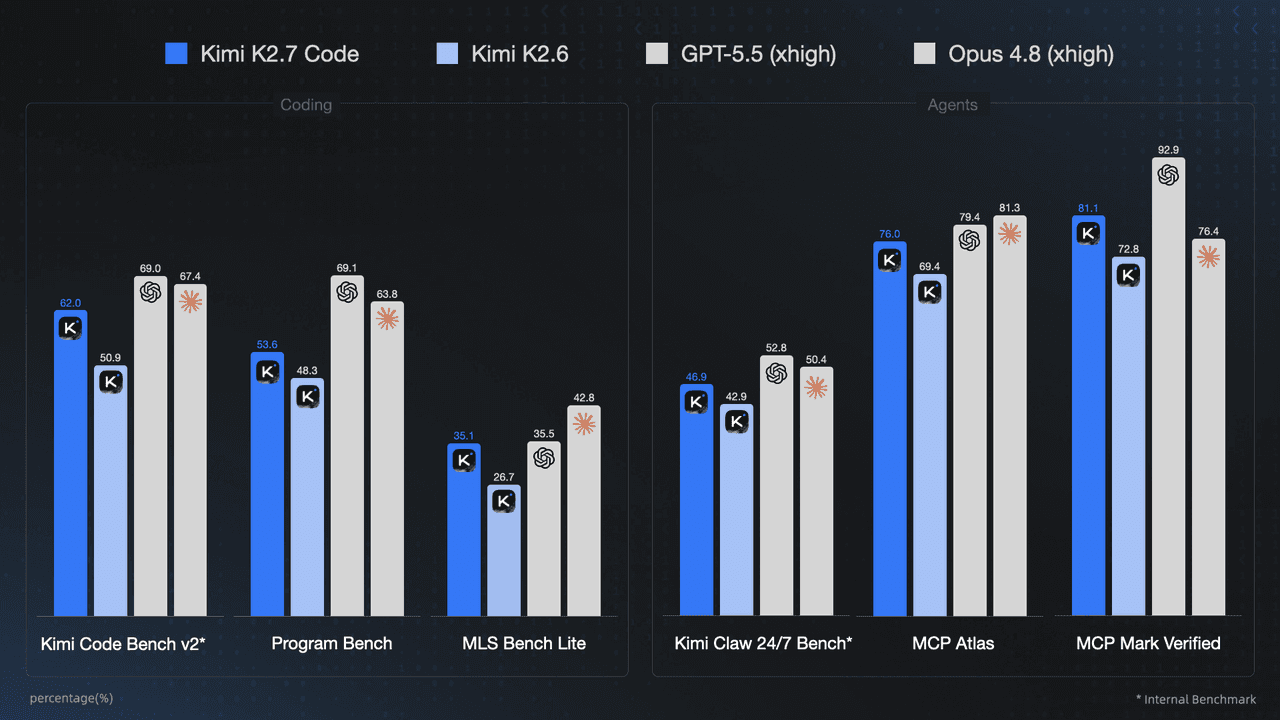
The stronger signal comes from the type of work being evaluated. Kimi Code Bench v2 covers production incidents, infrastructure work, systems programming, performance engineering, frontend development, security, and ML engineering. These tasks require the model to inspect context, make several dependent decisions, use tools, and continue working after intermediate failures.
K2.7 Code also remains competitive on tool-using agent evaluations. Moonshot reports 76.0 on MCP Atlas and 81.1 on MCP Mark Verified, placing the model in the same practical range as frontier proprietary systems across selected tool-use workloads.
The benchmark results do not establish K2.7 Code as a universal replacement for every closed coding model. They make the deployment question worth asking. Teams running coding agents can now compare capability alongside latency, data control, serving cost, and the ability to tune infrastructure around their own workload.
Deploying Kimi K2.7 Code in production
Kimi K2.7 Code is large enough that deployment decisions begin before the first request reaches the runtime. The model needs a practical weight format, enough aggregate memory for model residency and KV cache, and a parallelism strategy that can move tokens through its MoE layers without turning communication into the dominant source of latency.
Moonshot supports the model across vLLM, SGLang, and KTransformers, but the available deployment paths solve different problems. The official GPU serving recipes focus on single-node TP8 deployments, while KTransformers also provides a heterogeneous CPU and GPU path for teams willing to trade a more complicated system architecture for different hardware economics.
The production configuration should therefore follow the workload. A text-only coding assistant, a multimodal debugging agent, and a persistent repository agent can all use K2.7 Code while placing very different demands on memory, cache capacity, and decode performance.
Why native INT4 changes the deployment baseline
Kimi K2.7 Code ships with native INT4 weights, which makes serving a 1T-parameter model practical on a single high-memory eight-GPU node.
The official vLLM deployment recipe verifies the model on 8x H200 GPUs and gives roughly 640 GB of aggregate VRAM as the deployment requirement. The validated configuration uses tensor parallelism across all eight GPUs.
Deployment path | Configuration | Practical role |
vLLM | 8x H200, TP8 | Verified single-node INT4 deployment |
SGLang | 8x H200, TP8 | Alternative single-node serving path |
vLLM on AMD | 8x MI300X or MI325X | W4A16 MoE deployment with AITER |
vLLM on AMD | 8x MI350X or MI355X | Optimized FlyDSL INT4 MoE path |
KTransformers + SGLang | CPU and GPU heterogeneous | Specialized lower-cost hardware path |
INT4 changes the model-residency problem, but it does not make K2.7 Code a small model. The deployment still needs room for KV cache, runtime buffers, CUDA graphs, active sequences, and any multimodal processing state required by the workload.
The verified H200 configuration therefore represents a serving baseline rather than a guarantee of production capacity. Two deployments using the same eight GPUs can support very different concurrency levels depending on context length, reasoning duration, and the number of long-lived agent sessions sharing the node.
Runtime support also differs across hardware platforms.
vLLM also documents separate AMD deployment paths for MI300X and MI325X using AITER and INT4 QuickReduce, while MI350X and MI355X use the optimized FlyDSL W4A16 MoE backend.
Kimi K2.7 Code deployment therefore depends on the combination of model format, runtime support, kernels, and GPU topology. Aggregate VRAM determines whether the model can fit. The serving stack determines how efficiently the model can use that capacity.
How 256K context and persistent thinking consume capacity
Kimi K2.7 Code supports a 256K context window, but the practical limit depends on how coding sessions grow over time.
A repository agent can carry source files, shell output, test results, tool responses, generated patches, and previous reasoning through the same session. The cache footprint grows as the task progresses, which reduces the number of additional sequences the deployment can serve concurrently.
Persistent thinking adds another dimension to capacity planning. K2.7 Code always reasons before responding, and reasoning length can vary sharply between tasks. A small code edit may finish quickly, while a repository-scale debugging task can remain active through long decode phases and repeated tool interactions.
Average prompt length therefore says very little about the real serving workload. Production sizing needs to account for context growth, reasoning-token distribution, session duration, and concurrent active agents.
Adjusting memory utilization or parallelism settings can help when a deployment hits OOM conditions. The practical context limit still depends on the memory left after model residency, runtime overhead, and other active sessions.
When to remove MoonViT from the serving path
Many Kimi K2.7 Code deployments will never need the model’s vision encoder.
Terminal agents, repository automation, CI debugging, and code-review systems usually operate through text and structured tool output. The official vLLM deployment recipe supports --language-model-only for those workloads, allowing MoonViT to be skipped and the memory returned to the serving budget.
Visual debugging agents and browser-based agents can retain the multimodal path. vLLM recommends running MoonViT in data-parallel mode because the encoder is small relative to the language model and gains little from additional tensor-parallel communication.
Why MoE routing makes topology and parallelism important
Kimi K2.7 Code activates 32B parameters per token, but the complete 1T-parameter expert set still has to remain distributed across the system.
The documented H200 deployments use tensor parallelism across eight GPUs on a single node. MoE routing then adds communication as tokens move toward their selected experts, making interconnect quality and runtime implementation relevant to latency.
Hardware-specific runtime paths reinforce that point. vLLM uses different INT4 and MoE kernel paths across H200 and AMD deployments, while newer MI350X and MI355X configurations use a FlyDSL W4A16 backend with its own parallelism constraints.
Enough VRAM gets the model loaded. Efficient token movement determines whether the deployment serves it well.
Why coding-agent latency needs session-level measurement
Kimi K2.7 Code can return a fast first token and still take a long time to finish the task.
A coding agent may reason, call a tool, inspect the result, generate more reasoning, and repeat the cycle several times. TTFT and decode speed capture only pieces of that workflow.
Production benchmarking should also track queueing time, tool turnaround, total task duration, context growth, and tail latency under mixed traffic.
A deployment serving both short interactive requests and long repository agents needs to answer a simple question: do expensive sessions delay everyone else?
Production challenges when serving Kimi K2.7 Code
Kimi K2.7 Code combines several expensive workload characteristics inside the same deployment: a 1T-parameter MoE backbone, long contexts, mandatory thinking, persistent reasoning across turns, and tool-driven agent sessions.
Long-lived cache pressure: Repository agents can keep large contexts active across many turns. Several persistent sessions can consume KV cache headroom much faster than short coding requests.
Reasoning-token variance: K2.7 Code always runs in thinking mode, so similarly sized prompts can create very different decode workloads and occupy serving capacity for different lengths of time.
MoE communication overhead: Expert routing introduces communication across the serving topology. Poor parallelism choices or weak interconnects can increase latency even when the deployment has enough aggregate VRAM.
Mixed request shapes: Short interactive coding requests can share the same endpoint with long repository agents. Expensive sessions can increase queueing and tail latency for lighter requests when the serving stack treats all traffic the same way.
Tool-driven request chains: Coding agents repeatedly leave the model, execute tools, return with new context, and resume generation. Capacity planning needs to account for the full session rather than treating each model call as an independent request.
Multimodal overhead: Visual coding workflows need MoonViT, while text-only systems can skip the encoder and recover memory for KV cache and active sessions.
Kimi K2.7 Code can fit on a verified eight-H200 deployment and still perform poorly under the wrong traffic mix. Production latency depends on how context growth, reasoning duration, tool cycles, queueing, and GPU communication interact across the full agent session.
How PipeShift deploys Kimi K2.7 Code for low latency
Kimi K2.7 Code deployment starts with the workload. A short interactive coding assistant needs a different serving configuration from a repository agent that carries large contexts, persistent reasoning, and repeated tool calls through one long session.
PipeShift benchmarks prompt length, context growth, output length, concurrency, and latency targets before tuning the runtime, GPU configuration, parallelism strategy, memory allocation, and batching behavior.
K2.7 Code makes workload separation especially important. Long-running agents can occupy cache and decode capacity for extended periods, while shorter coding requests still need predictable response times. PipeShift uses workload-aware placement, warm model capacity, and serving policies that keep expensive sessions from degrading interactive traffic.
Low latency also depends on the full serving path. Queueing, proxy overhead, runtime configuration, memory pressure, GPU communication, and model execution all contribute to the latency experienced by the coding agent.
For Kimi K2.7 Code, the deployment target is clear: keep enough capacity warm, preserve memory headroom for growing sessions, and serve different coding workloads according to how they actually behave in production.
Frequently asked questions about Kimi K2.7 Code deployment
Can Kimi K2.7 Code run on a single GPU?
The full Kimi K2.7 Code model is not designed for practical production deployment on a single conventional data-center GPU. The verified deployment paths distribute the model across multiple high-memory GPUs.
How much VRAM does Kimi K2.7 Code need?
The practical requirement depends on the runtime, context length, concurrency, and deployment path. The documented INT4 configuration uses roughly 640 GB of aggregate VRAM, while additional memory is still needed for KV cache, runtime state, and active sessions.
Does Kimi K2.7 Code always use thinking mode?
Yes. Kimi K2.7 Code runs with thinking enabled, and preserve_thinking keeps the reasoning state available across turns. That behavior fits long-running agent workflows but also increases variation in decode time and session cost.
Can Kimi K2.7 Code run without the vision encoder?
Yes. Text-only deployments can remove the MoonViT path and use the recovered memory elsewhere in the serving budget. This is useful for terminal agents, repository automation, CI debugging, and other workflows that never consume visual input.
What is the best runtime for Kimi K2.7 Code?
There is no universal best runtime for every deployment. The right choice depends on hardware, kernel support, parallelism strategy, multimodal requirements, and the workload’s latency profile. Teams should benchmark the available serving paths against real prompt lengths, session durations, reasoning behavior, and concurrency.
Is Kimi K2.7 Code suitable for production coding agents?
Kimi K2.7 Code is designed for long-horizon coding and agentic software engineering workloads. Production suitability still depends on the application’s own task success rate, tool-use behavior, latency target, concurrency, and infrastructure cost.
Can Kimi K2.7 Code replace proprietary coding APIs?
Kimi K2.7 Code is strong enough on selected coding and tool-use workloads to justify a migration evaluation. Teams should compare it against the proprietary model they currently use on their own repositories, agent harnesses, tool calls, latency requirements, and serving economics.